
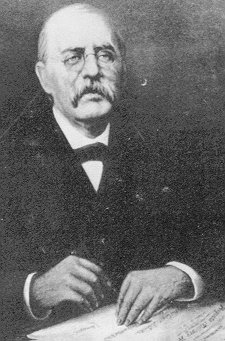
From a painting that hung in the Reception Room of Main Barracks
The Founder
Charles Summerville Roller
1839 — 1907 · Founder, Augusta Military Academy
Soldier, legislator, and one of the most successful teachers of his day.
Researched & written by Duke Fancher, ’58
1839
Born · Mount Sidney
1861
Enlists · C.S.A.
1865
Begins Teaching
1874
Augusta Male Academy
1890
Renamed A.M.A.
1907
Death · Ft. Defiance
When Charles Summerville Roller died in August of 1907, he was known as one of the most successful teachers of his day. His legacy is ours — the Augusta Military Academy and all that it stands for.
In addition to his scholastic qualifications, he possessed rare abilities as an administrator and had few equals as a disciplinarian. His success was based in part on his genial disposition and his high estimate of his profession as a teacher, and he was always an active contributor in his community. For more than fifteen years he served as a justice of the peace in his magisterial district of Augusta County; he served in the State Legislature, worshipped at the Old Stone Church, and took part in local civic and social organizations. His legacy was one of service — and the founding of a school that achieved an international reputation for excellence in secondary-level military education.
Ch. I
Origins & Education
Charles S. Roller was born 8 May 1839 in Mount Sidney, Virginia, the oldest of seven children of Jacob and Margaret Roller. Four of his siblings died before their fifth birthday, so he grew up with two brothers — one two years younger, the other fifteen. Jacob Roller was a farmer and merchant, and both he and his father, Peter, were postmasters at Mount Sidney.
There were no public schools in Augusta County before the Civil War, and Charles received his early education at local private schools, including the Mossy Creek Academy during the time Jed Hotchkiss was its principal. He worked most summers as a farmhand for his father, and as a youth he was known for his athletic abilities, his horsemanship, and his devotion to his books. He attended the University of Virginia for two years, 1859–1861.
Stonewall Jackson's aide
The mapmaker who shaped a friendship
Jed Hotchkiss was principal of the Mossy Creek Academy when Roller attended classes there before entering the University of Virginia in 1859. Hotchkiss went on to serve as General Thomas J. Jackson’s Civil War topographical engineer, mapping the Shenandoah Valley on Jackson’s orders in 1862 — an assignment that brought him celebrity and honors during and after the war.
A friend of the Roller family, his diary records nights spent in the Roller home at Mount Sidney during Jackson’s 1862 Valley Campaign. He and Charles Roller maintained a lifelong friendship, and Hotchkiss delivered the commencement address at AMA on June 1, 1898.
Ch. II
The War Years
On 24 July 1861, three days after the First Battle of Bull Run, Roller enlisted as a private in the Confederate forces at Fairfax Court House. He joined General J. E. B. Stuart’s 1st Virginia Cavalry Regiment, serving four years with Company E — organized in Waynesboro and composed almost exclusively of men from Augusta County. The company was known as the Valley Rangers.
The Valley Rangers fought in skirmishes and battles throughout the war, suffering casualties at Port Republic, Chancellorsville, Gettysburg, Spotsylvania, Cedar Creek and many other places. On 8 April 1865, riding as a courier for General Fitzhugh Lee’s command near Appomattox Court House, Roller was thrown by his horse, captured, and made a prisoner of war. The following day Lee surrendered to Grant, ending the war in Virginia and prompting Roller’s release.
War came to the very doorstep of the land that would one day become the Academy.
The war at the doorstep
VMI cadets marched past
Though no battles were fought in Mt. Sidney or Ft. Defiance, residents along the Valley Pike witnessed the constant movement of troops, artillery and supply wagons. On 11 May 1864, over 250 cadets from the Virginia Military Institute began their historic march from Lexington toward their engagement with fame at New Market — passing through Ft. Defiance on 13 May, just a few feet from the land eventually to become the home of Augusta Military Academy.
On 5 June 1864, the Battle of Piedmont — barely four miles east of Ft. Defiance — brought the carnage of war to the doorsteps of area residents. Over 7,700 Union troops under General Hunter fought 5,600 Confederates for more than nine hours in the fields north of New Hope. One in ten soldiers on each side was killed or wounded.
Ch. III
Homecoming & the First Classrooms
Parts of the Shenandoah Valley had been devastated. Homes, barns, livestock and crops were destroyed; lives were lost; and there had been no educational opportunities for the area’s young people for four years. It was to this scene, at the age of twenty-five, that Charles Roller returned home. He intended to go back to the University of Virginia to study law — but tradition suggests he was asked by Confederate veterans to begin teaching and resume the education of young men who had not seen blackboards or textbooks for years.
In September of 1865, five months after the war’s end, Roller joined C. M. Packer as a teacher in the school at the Augusta Church. Beginning in September of 1866 he became Principal of the Old Fort Academy, arranging boarding for students in nearby homes; the cost for a five-month term of “Advanced English” and “Languages” was $45.00, payable at the end of each term.
On 7 November 1871, Roller was elected to the Virginia State Legislature as a member of the Conservative Party. In the House of Delegates he served on the committees of education, schools and colleges, and public appropriations. His time in the Legislature ended in April of 1873, and it is believed he continued to manage the school during his brief absences.
Ch. IV
The Academy Takes Root
In 1874 he moved his school from the immediate area of the Augusta Church to a newly erected frame building a short distance to the south, and the name became Augusta Male Academy. That same year, on 26 October 1874, Charles Roller married Rosabelle Moorman. The couple had four children — Margaret Belle, William C., Thomas J., and Charles S. Jr. — two of whom would follow their father into lifelong commitments to secondary education.
On 1 December 1879, Roller purchased the land south of the Augusta Church that became the eventual site of every building of the academy, as well as the Roller Home. By the 1879–80 session, half of the thirty students came from outside the local community. A program of military instruction — uniforms and Civil War–style muskets for drill — was adopted by 1880. The only precedent in Virginia was VMI, making Roller’s the first of several military preparatory schools in the state.
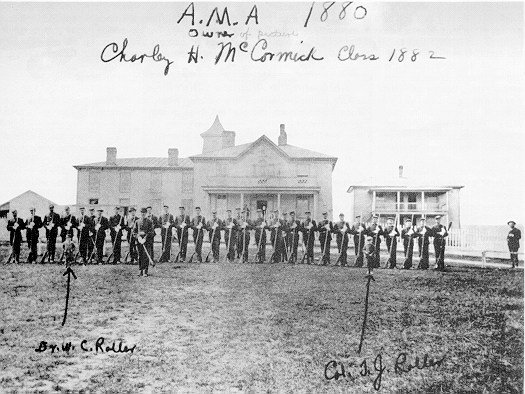
Augusta Male Academy Corps of Cadets, 1880. The figure at far right is believed to be Professor Roller.
Ch. V
Life in the Frame Barracks
In the 1880s, life in the original frame barracks lacked the conveniences of later years. Rooms held two boys and a single small wood-burning stove; each cadet took a turn carrying kindling from the academy woodpile. Beds were wooden frames with rope springs and corn-shuck mattresses, and after-dark study depended on a coal-oil lamp. Since coal oil also lit the little stoves on cold mornings, there was much sport in “borrowing” a roommate’s precious supply.
Saturday was woodchopping day: the boarding students split and stacked a week’s worth of logs, and the sooner the pile reached the required size, the sooner they escaped for recreation. So long as there was neither snow nor a temperature low enough to cramp the fingers, marbles was reportedly the game. Saturday nights belonged to the Literary Society, devoted to debate, elocution and declamation — for Roller believed no man was truly educated until he could stand on his own two feet and convey his ideas by his own voice.
AMA & the Augusta Church
Beginnings among the old, tall trees
AMA began in a building that once stood in the churchyard of the Old Stone Church, one of the most historic structures in the Shenandoah Valley. The congregation dates from about 1737, and the stone building cadets came to love held its first worship service on 22 January 1749.
A 1921 expansion of the church was required in part by the increased enrollment of Augusta Military Academy. At the church’s 150th anniversary in 1899, a company of AMA cadets stood in line beside a crowd of some two thousand, contributing to a most imposing and touching scene.
Ch. VI
The Professor
The 1880s curriculum spanned Greek, Latin, French, German, English, U.S. History, geometry, algebra, elocution, physics, word-analysis, literature and surveying. Roller taught daily. An imposing figure, he was also very nearsighted: his bifocals obliged him to sit bolt upright so his line of sight passed through the lower lenses.
Tobacco chewing was an accepted custom, and the Professor enjoyed it — as did many of his students, sometimes in class. His favorite retreat was his study, lined with bookcases and centered on a large upholstered swivel chair. Boys behind in their studies spent evenings there under his instruction. Because his high-backed chair required a half-turn to face the door, it was considered quite an accomplishment for a cadet to transfer a pinch of the Professor’s tobacco from the mantle box to his own pocket before the Professor had completed his turn.
Roller and his family worshipped at the Augusta Stone Presbyterian Church, and he insisted his students attend services too. He briefly suspended the academy for 1883–84 after his political appointment as Principal of the Virginia School for the Deaf and Blind in Staunton, resuming operations of Augusta Male Academy on 24 September 1884.
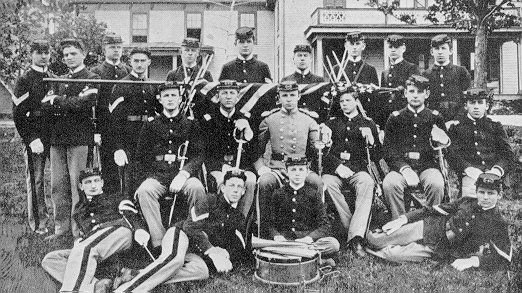
Cadet officers from the academy’s catalog for 1895–96. The first Recall was published around 1913.
Ch. VII
Augusta Military Academy
During 1888–89 the Professor renamed the school the Augusta Classical and Military Academy, and by 1890 it had become simply Augusta Military Academy. The founding date has long been discussed: the cornerstone of the 1910 academic building reads AMA 1874, while the 1905–06 catalog identifies the session beginning September 1906 as the school’s thirty-second.
Roller’s Civil War service had been that of an enlisted man, but he was later a Colonel in the Virginia militia and was frequently given a military title in print. To his students he was “The Professor” or “The Old Boss.” He was Deputy Grand Master in Virginia of the Independent Order of Odd Fellows and several times commander of the Staunton-based Stonewall Jackson Camp of Confederate veterans.
The Academy celebrated its 100th anniversary in 1965, dated to the beginning of the Professor’s teaching career in Ft. Defiance in 1865. After his funeral on 28 August 1907, a newspaper reported that the cortege passed over the spot in the churchyard where Roller first taught when he established Augusta Military Academy. That was indeed the seed from which grew that beloved school.
His Legacy
“The seed from which grew that beloved school.”